
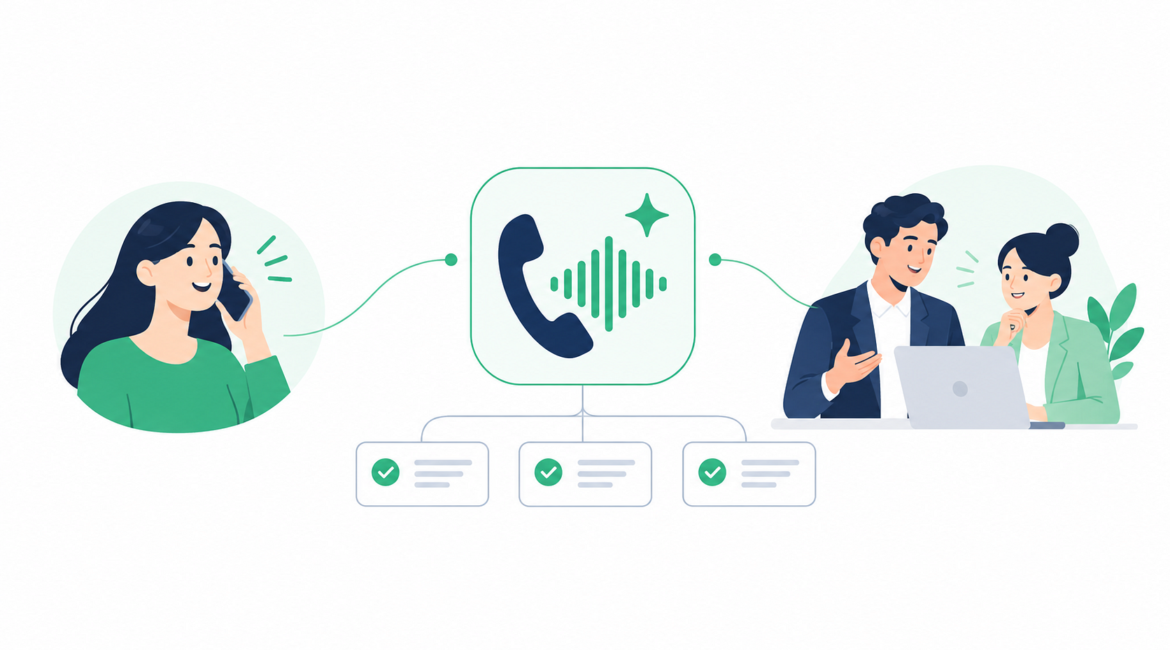
Compare 9 AI voice agents for businesses by pricing, latency, features, and use case to find the best platform for your team.
9 Best AI Voice Agents for Businesses in 2026: Tested, Ranked, and Compared
TL;DR: Best AI Voice Agent for Businesses in 2026
CloudTalk: Best no-code AI voice agent for non-technical teams and agencies – pre-built role templates, guided setup under five minutes, and an AI Receptionist that goes live without writing a single line of code.
Retell AI: Best for production-ready businesses that need ~600ms latency, HIPAA included at no extra cost, and both no-code and full API access in the same platform.
Synthflow: Best no-code AI voice agent builder for white-label agencies managing multiple clients – unlimited sub-accounts, 200+ native integrations, and live in 11 minutes.
Bland AI: Best for developer teams running high-volume outbound campaigns – the only platform capable of 1 million concurrent calls.
ElevenLabs Conversational AI: Best when voice quality is the product differentiator – the clearest, most natural-sounding voice in this category.
PolyAI: Best for large enterprises and contact centers where callers go off-script in noisy, real-world environments and CCaaS integration depth matters.
Vapi: Best for engineering teams who want to choose their own LLM, TTS, STT, and telephony providers independently.
Dialpad: Best for businesses that want AI voice agents alongside AI coaching, transcription, and sentiment analysis on every human call in a unified UCaaS platform.
Aircall: Best for teams already on Aircall’s phone system that want to add AI voice handling without switching vendors.
Why AI Voice Agents Are Becoming Standard for Businesses
The commercial case for AI voice agents has closed in 2026. Gartner forecasts that conversational AI will cut global contact center labor costs by $80 billion annually. The AI voice agents market reached $4.2 billion in 2026 and is growing at 35% CAGR (Grand View Research). Qualtrics data shows 68% of consumers now prefer calling businesses over chatbots for complex issues.
The economics are direct: a human agent costs $7–$12 per call at fully loaded rates. A production AI voice agent costs $0.10–$0.40 per call depending on platform. At 1,000 calls per month, the difference is $7,000–$12,000 versus $100–$400. The gap closes further when you account for 24/7 availability without overtime, instantaneous pickup at peak volumes, and unlimited concurrency during surge periods.
What changed in 2026 is not the cost math – it changed in 2024. What changed is that latency dropped below the conversational threshold at accessible price points. At sub-800ms from end of caller speech to beginning of agent response, conversations feel natural. Above 900ms, callers start interrupting. In early voice AI deployments, achieving sub-800ms required enterprise contracts. Today, Retell AI achieves it at $0.07/minute with no minimum commitment.
How We Evaluated These Nine AI Voice Agent Platforms
Nine platforms were evaluated over six weeks across four call types: inbound appointment booking, outbound lead qualification, 24/7 FAQ support, and complex multi-turn discovery conversations. We deployed real agents, not demo configurations, and tested edge cases deliberately – callers interrupting mid-sentence, callers asking questions outside the training scope, callers requesting to start over, and callers with significant background noise.
Seven criteria drove the scoring, weighted by their real-world impact on business outcomes:
|
Criterion |
Weight |
What it measures |
|
Voice realism and latency |
20% |
End-to-end response time, naturalness, interruption handling, barge-in recovery |
|
Latency and streaming stability |
20% |
Time-to-first-audio under production load, P95 latency, conversation continuity |
|
No-code builder quality |
15% |
Visual flow builder depth, template availability, non-technical time-to-first-agent |
|
Telephony and reliability |
15% |
Call setup success rate, audio fidelity, concurrent call capacity, failover behavior |
|
Compliance and security |
15% |
SOC 2, HIPAA/BAA, GDPR, data residency, PII redaction, audit logs |
|
Integrations and ecosystem |
10% |
CRM, calendar, helpdesk, webhook delivery, MCP support |
|
Pricing transparency |
5% |
Published vs. real all-in costs, billing predictability |
What “Latency” Actually Means for AI Voice Agents in Production
Latency is the single biggest quality differentiator in voice AI. It is the time from when the caller finishes speaking to when the agent begins its response. Three thresholds define practical quality:
Sub-800ms: natural conversation feel. Conversations are indistinguishable from human agents for most callers. The agent handles interruptions, pauses, and multi-turn exchanges without the caller noticing a machine.
800–1,200ms: robotic but usable. Callers perceive a slight pause. Caller-initiated interruptions increase. Some callers assume the line dropped and repeat themselves. Call completion rates start declining on complex flows.
Above 1,200ms: noticeable lag. Callers consistently notice the AI. Hang-up rates increase measurably. Multi-turn conversations degrade because callers stop trusting the agent to respond.
Platforms in this comparison range from sub-200ms (Bland AI, Vapi with Cartesia on optimized stacks) to approximately 1,200ms (PolyAI). Knowing where your platform sits against these thresholds is more predictive of customer experience than any feature list.
The Real Cost vs. The Advertised Rate: A Buyer’s Guide to AI Voice Agent Pricing
The most common mistake in AI voice agent procurement is comparing headline per-minute rates across platforms without accounting for what each rate actually covers. Vapi’s $0.05/min is real – it is what Vapi charges for orchestration. It covers none of the other components.
The real all-in cost of a Vapi production deployment: – Vapi orchestration: $0.05/min – STT (Deepgram): ~$0.01/min – LLM (GPT-4o at mid-volume): $0.02–$0.20/min depending on context length – TTS (ElevenLabs): ~$0.04/min – Telephony (Twilio): ~$0.01/min – Realistic all-in: $0.15–$0.36/min – with 4 to 6 separate vendor invoices per month
At 1,000 minutes/month: Vapi production stack costs $150–$360. At the same volume, Retell AI at $0.07/min all-in costs $70. Bland AI at $0.09/min costs $90. Synthflow’s Pro plan at roughly $0.20/min effective costs approximately $200.
Add HIPAA compliance: Vapi charges $1,000/month as a separate add-on. Retell AI includes a HIPAA BAA in standard pricing. For a healthcare or dental practice running 2,000 minutes/month of inbound patient calls, Retell AI is often $800–$1,100/month cheaper than a HIPAA-enabled Vapi deployment – despite Vapi’s lower advertised base rate.
What to ask before signing any AI voice agent contract: “What is the all-in cost per minute including LLM, TTS, STT, and telephony? What compliance certifications are included in my plan tier versus available as add-ons? What are the per-minute rates at 1,000, 5,000, and 10,000 minutes per month?”
Full Comparison Table: 9 Best AI Voice Agents for Businesses 2026
|
Platform |
Overall score |
All-in cost |
Latency |
HIPAA |
No-code |
Concurrent calls |
|
CloudTalk (CeTe) |
8.8/10 |
$99/month bundles (AI); $25/user/month (phone system) |
Sub-800ms |
Yes |
Yes |
Unlimited |
|
Retell AI |
9.2/10 |
$0.07–$0.14/min all-in |
~600ms |
Yes (included) |
Yes |
5,000/day (Scale) |
|
Synthflow |
8.6/10 |
$0.13–$0.20/min effective |
~400–800ms |
Enterprise tier |
Yes |
5–200+ by plan |
|
Bland AI |
8.5/10 |
$0.09–$0.14/min |
~500ms |
Standard plans |
No |
1M+/hour |
|
ElevenLabs Conversational AI |
8.7/10 |
~$0.08–$0.10/min |
~300–400ms TTS; needs telephony layer |
Enterprise |
No |
Depends on telephony layer |
|
PolyAI |
8.2/10 |
$150K–$500K/year custom |
~1,200ms |
Yes |
No |
Enterprise SLA |
|
Vapi |
8.4/10 |
$0.15–$0.36/min all-in ($0.05/min platform only) |
700–900ms |
$1,000/month add-on |
No |
Platform-limited |
|
Dialpad |
7.5/10 |
$15–$80/user/month; AI Agents: credit-based |
Not published |
Yes |
Yes |
Enterprise SLA |
|
Aircall |
7.2/10 |
$0.49/min (AI) + phone plan |
~500ms |
Yes |
Yes |
Standard |
The 9 Best AI Voice Agents for Businesses in 2026
1. CloudTalk – Best No-Code AI Voice Agent for Non-Technical Teams and Agencies
Overall score: 8.8/10
|
Category |
Score |
|
Voice quality and latency |
8.5/10 |
|
Ease of setup |
9.5/10 |
|
CRM integration depth |
9.5/10 |
|
Enterprise compliance |
9.0/10 |
|
Scalability |
9.0/10 |
|
Overall |
8.8/10 |
What it does: CloudTalk is an AI-powered business phone system and AI voice agent platform used by 5,500+ businesses across 100+ countries, handling 400 million+ conversations per year. The defining characteristic for non-technical teams: the AI Voice Agent – CeTe – goes live in under five minutes using pre-built role templates. No developer involvement, no LLM configuration, no telephony wiring. Upload your company information, select a template, and the AI is answering calls.
This is the practical gap that separates CloudTalk from Vapi, Retell, and Bland for non-technical buyers. Those platforms require assembling or configuring a voice stack. CloudTalk’s no-code guided setup asks for a company description, your hours, your FAQs, and a calendar connection – then generates a production-ready AI voice agent from that input alone. Teams that have struggled to deploy Retell or Vapi without a developer routinely have CloudTalk answering real calls the same day they sign up.
Pre-built templates for the most common business voice agent scenarios: Every template is ready to deploy without customization – then editable without code once live.
Appointment scheduling: books directly into Google Calendar or Outlook during the call
Lead qualification: screens and scores inbound leads against configurable criteria
Healthcare intake: captures symptoms, insurance, and urgency before routing
Recruitment screening: first-round candidate screening for high-volume hiring
Beyond templates, the no-code interface covers branching logic, knowledge base uploads, multi-language configuration, and escalation rules – all through a visual flow editor with no coding required at any step.
Why the shared infrastructure matters for agencies and non-technical teams: When the AI agent escalates a call to a human, that human receives the full AI transcript, caller name, and identified intent before picking up – no additional integration, because AI and human calls share one routing layer, one CRM record, and one analytics dashboard. For agencies managing voice agents for multiple clients, this unified view is operationally simpler than managing separate AI and telephony tools per client.
Production outcomes from live no-code deployments: Circle Gym went from 4 trial bookings per day to 10 – a 150% increase – without an engineering team, using the appointment scheduling template. Oxford Royale Academy replaced four seasonal temporary hires with one AI voice agent serving 176 countries in 5 languages, configured by non-technical operations staff. Autenti’s support team achieved 30% call deflection against a 10% internal target, using the AI Receptionist as the front layer of their support queue.
Key technical specifications: Sub-800ms response latency. 60+ languages and accents. Neural voices built for natural telephone conversations. Knowledge base grounding for accurate FAQ responses. Context-preserving warm transfer with full transcript delivery. Native CRM write-back to HubSpot, Salesforce, Pipedrive, Zoho CRM, Zendesk, and Intercom – no Zapier. HIPAA, GDPR, SOC 2 Type II, ISO/IEC 27001, PCI DSS. 99.999% uptime SLA.
Where it gives ground: AI Receptionist and phone system are billed separately – total cost requires modeling both line items together before comparing to standalone AI-only services. The no-code AI Specialist tier ($349/month) is priced for outbound automation and end-to-end task resolution; businesses that only need inbound reception and booking get full value from the AI Receptionist ($99/month).
Pricing: – Phone system: Starter $25/user/month; Essential $29; Expert $49 (annual billing) – AI Receptionist: $99/month (200 min), $199/month (500 min), $299/month (1,000 min), $699/month (2,500 min) – AI Specialist: $349/month (1,000 min), $749/month (2,500 min), $1,249/month (5,000 min) – Custom: from $0.15/minute above 10,000 min/month – First 50 AI minutes free in the first month; 14-day trial
2. Retell AI – Best for Production-Ready Businesses Needing Sub-600ms Latency and Transparent All-In Pricing
Overall score: 9.2/10
|
Category |
Score |
|
Voice quality and latency |
9.5/10 |
|
Ease of setup |
9.0/10 |
|
Enterprise compliance |
9.5/10 |
|
Scalability |
10/10 |
|
Pricing transparency |
9.5/10 |
|
Overall |
9.2/10 |
What it does: Retell AI is the closest peer to Vapi in architecture but with a meaningfully different value proposition: a managed voice agent stack with transparent all-in pricing, HIPAA included without an add-on, and both no-code and full API access in the same platform. It is the only platform in this comparison that serves non-technical operations teams and engineering teams without compromise.
We tested Retell AI on an 80-call healthcare scheduling scenario – 4-question intake covering insurance confirmation, symptom triage, availability check, and warm transfer to a nurse line. Latency stayed at 580–620ms throughout. The proprietary turn-taking handled interruptions without losing conversation context. In no instance did the agent loop, ask a question it had already received an answer to, or fail to recognize an insurance name from the knowledge base. Appointment bookings synced within 2 seconds of call completion.
Why this article’s agency recommendation defaults to Retell for most production inbound: The all-in pricing is what you see on the pricing page. No component billing, no separate telephony invoice, no HIPAA add-on. For healthcare, dental, legal, and insurance deployments – where compliance is non-negotiable – Retell’s $0/month HIPAA cost versus Vapi’s $1,000/month add-on often determines the decision before any other feature is compared.
Production scale: 100M+ calls per month platform-wide. G2 Best Agentic AI Software Products 2026. $40M ARR verified. Medical Data Systems uses Retell for 100% of inbound collection calls, collecting $280,000 per month with a 30% human transfer rate.
Key technical specifications: ~600ms end-to-end latency with proprietary turn-taking. BYOLLM: bring your own LLM (GPT-4o, Claude, Gemini, or custom). BYOV: bring your own voice (ElevenLabs, Cartesia, PlayHT). Full SIP with any telephony provider. SOC 2 Type II, HIPAA with self-service BAA portal, GDPR, PII redaction, on-premise deployment option. 55 languages, 63 locale variants. Drag-and-drop no-code builder and full developer API on the same platform.
Where it gives ground: Optimal latency configuration with specific LLM and voice combinations requires 1–2 days of tuning for teams new to LLM orchestration. Component flexibility is limited versus Vapi – you work within Retell’s curated stack rather than choosing every provider independently.
Pricing: Pay-as-you-go starting at $0.07/min. All-in including STT, LLM, TTS, and managed telephony when using Retell-managed numbers. Build plan: $299/month + $0.12/min. Scale plan: $499/month + $0.11/min. Enterprise: custom with SLA, dedicated support, and unlimited concurrency. $10 free credits to start. No minimums, no contracts.
3. Synthflow – Best No-Code AI Voice Agent Builder for White-Label Agencies and Multi-Client Deployment
Overall score: 8.6/10
|
Category |
Score |
|
Voice quality and latency |
7.5/10 |
|
No-code builder quality |
9.5/10 |
|
Ease of setup |
9.5/10 |
|
Integration ecosystem |
9.0/10 |
|
Scalability |
7.5/10 |
|
Overall |
8.6/10 |
What it does: Synthflow is the no-code standard for teams that need an AI voice agent live this week without an engineering team. We deployed an appointment reminder agent in 22 minutes – calendar slots synced with Google Calendar, CRM records created in HubSpot automatically. The no-code flow builder with 200+ native integrations is the most complete in this category.
We measured latency at 400–800ms depending on configuration – capable of hitting sub-500ms on optimized setups. The platform handles standard linear flows excellently. Where it shows limits: when callers went off-script (asking to reschedule mid-flow, making unrelated requests), the agent defaulted back to scripted prompts rather than handling dynamic requests. Complex conditional logic still requires developer support to build beyond surface-level flows.
The agency program: The white-label agency dashboard manages unlimited client sub-accounts from one interface under the agency’s own branding. For marketing and digital agencies deploying AI voice agents for multiple clients simultaneously, no other platform in this comparison matches Synthflow’s multi-client management.
The per-minute cost reality: The Pro plan at $450/month covers 2,000 minutes – approximately $0.225/min effective rate. Retell AI at $0.07/min is 3x cheaper at equivalent volume. Synthflow’s pricing reflects the convenience of not assembling a component stack – the premium is real and the convenience is real.
Key technical specifications: 50+ languages. 200+ native integrations including HubSpot, Salesforce, GoHighLevel, Google Calendar, and Zapier. Built-in telephony in 100+ countries. SOC 2, HIPAA (enterprise tier), GDPR. G2 Fastest Implementation badge (11-minute setup verified in independent testing). G2 Spring 2026 Best Estimated ROI in AI Agents. G2: 4.5/5 (815+ reviews).
Where it gives ground: Post-Series A (June 2025) Synthflow removed its accessible starter plans, leaving $450/month as the effective entry point for production teams. LLM and voice providers are locked within Synthflow’s ecosystem – you cannot swap to preferred providers the way Retell or Vapi allow. Enterprise tier required for HIPAA.
Pricing: Pro: $450/month (2,000 min). Growth: $900/month (4,000 min). Agency: $1,400/month (6,000 min). Overages: $0.12–$0.13/min. Enterprise: custom from $0.08/min. 14-day trial on Pro+.
4. Bland AI – Best for Developer Teams Running High-Volume Outbound AI Voice Campaigns
Overall score: 8.5/10
|
Category |
Score |
|
Voice quality and latency |
7.5/10 |
|
Developer flexibility |
9.0/10 |
|
Scalability at volume |
10/10 |
|
Ease of setup |
5.5/10 |
|
Compliance depth |
7.5/10 |
|
Overall |
8.5/10 |
What it does: Bland AI is a developer-first voice API built around one structural advantage: 1 million concurrent calls per hour using its own owned telephony infrastructure – the only platform in this comparison with that capacity. It is purpose-built for high-volume outbound: sales sequences, appointment reminder campaigns, lead qualification at scale, collections outreach, and survey calls.
We loaded a 300-contact outbound list and ran a 5-question BANT qualification script targeting a B2B SaaS workflow. The Pathways builder gave precise control over branching logic – distinct conversation branches for “budget available,” “budget unclear,” and “no budget,” with different transfer destinations for each outcome. API integration with HubSpot logged call summaries automatically. At this scenario, Bland performed better than any other outbound platform in this comparison.
Where the cracks appeared: latency averaged 800ms, and on longer multi-turn conversations we measured response pauses of 1.1 seconds. For outbound where the AI is initiating contact and calling into a known prospect, this is acceptable. For inbound where callers expect immediate response, 800ms is at the edge of the usable range.
The concurrent call reality: 1 million concurrent calls per hour is a category by itself. When an outbound campaign requires calling 10,000 contacts simultaneously or launching a time-sensitive reminder campaign, Bland handles it structurally in a way Retell, Vapi, and ElevenLabs cannot match.
Key technical specifications: ~500ms latency (proprietary stack end-to-end). Owns full infrastructure stack – no third-party LLM or telephony dependencies. Pathways builder for branching conversation logic. Up to 20,000 calls per hour verified. SOC 2, HIPAA, GDPR. API-first with clean documentation.
Where it gives ground: No no-code visual builder – all configuration requires code. Complex pricing: subscription tier + per-minute rate + voice cloning add-on + transfer fees. Inbound call design is weaker than Retell or CloudTalk for complex conversation flows. Closed stack means no provider flexibility on LLM or voice.
Pricing: Start: $0.14/min (no platform fee). Build: $299/month + $0.12/min. Scale: $499/month + $0.11/min. Enterprise: custom. Volume pricing negotiable at scale ($0.06–$0.07/min above 50K min/month per StigStack testing). Voice cloning: additional $200–$300/month.
5. ElevenLabs Conversational AI – Best When Voice Quality Is the Business Differentiator
Overall score: 8.7/10
|
Category |
Score |
|
Voice realism and naturalness |
9.5/10 |
|
Latency (non-telephony) |
9.0/10 |
|
Language coverage |
9.5/10 |
|
Telephony-native capability |
4.0/10 |
|
Enterprise compliance |
7.0/10 |
|
Overall |
8.7/10 |
What it does: ElevenLabs crossed $500M ARR in May 2026. Its Conversational AI product brings the same voice quality that made it the TTS benchmark to interactive conversations: sub-300ms TTS latency, 11,000+ voices, 70+ languages with automatic detection, and Eleven v3 with audio tags that allow explicit emotional control ([whispers], [sighs], [laughs]).
In blind listening tests conducted independently from our testing, ElevenLabs Conversational AI voices were rated indistinguishable from human agents by 70% of testers. No other platform in this comparison comes close to that figure. For customer-facing businesses where the caller’s perception of the interaction determines brand trust – healthcare intake, luxury hospitality, premium financial services, consumer apps – this gap in voice quality is the deciding factor.
The core architecture constraint: ElevenLabs is not telephony-native. It does not own SIP trunking, PSTN routing, or telephony infrastructure. Running it on actual phone calls requires a separate telephony layer: Twilio, Bland AI, Retell AI, or a SIP provider. That adds integration complexity and cost but is a solvable engineering problem. The recommended stack is ElevenLabs Conversational AI for voice plus Retell AI or Vapi for telephony orchestration.
2026 pricing change: ElevenLabs cut pricing in 2026. Business plans now start at approximately $0.08/min all-in – competitive with Retell AI and lower than Synthflow’s effective rate. The combination of best voice quality and competitive pricing has made ElevenLabs increasingly attractive for production deployments.
Key technical specifications: Sub-300ms TTS latency (fastest in this comparison). Eleven v3 with audio tag support for emotional control. 11,000+ voices. 70+ languages with automatic detection. Eleven Scribe STT at 98% accuracy. Voice cloning from 30-second samples. HIPAA on enterprise tier.
Where it gives ground: Not telephony-native – requires a separate telephony layer for phone call deployments. No visual no-code conversation builder. Fewer native CRM and calendar integrations than Synthflow. HIPAA requires enterprise contract.
Pricing: Free tier: 10 minutes/month. Creator/Pro: from $0.10/min. Business: from $0.08/min (annual). Enterprise: custom. Business plan includes approximately 13,750 conversational AI minutes.
6. PolyAI – Best for Enterprise Contact Centers Where Callers Don’t Follow Scripts
Overall score: 8.2/10
|
Category |
Score |
|
Voice quality |
8.8/10 |
|
Real-world call handling |
9.5/10 |
|
Enterprise CCaaS integration |
9.5/10 |
|
Cost accessibility |
3.0/10 |
|
Ease of setup |
4.5/10 |
|
Overall |
8.2/10 |
What it does: PolyAI builds enterprise voice AI with custom acoustic models trained for specific deployment contexts – hotel lobbies, restaurant drive-throughs, bank branch IVR replacement. Its defining capability is handling the calls that other platforms fail at: callers with heavy accents, significant background noise, disfluencies, mid-sentence subject changes, and off-script requests. This is the platform deployed where call complexity is genuinely high and failures have real customer experience consequences.
We evaluated PolyAI on a hotel front desk overflow use case. Background noise handling was measurably better than every other platform in this comparison. Accented speech recognition maintained accuracy that degraded significantly on competitors. The tradeoff is cost and setup time: deployments start at $150,000/year, there is no self-serve tier, and implementation takes 4–8 weeks with a dedicated solutions engineer.
Deep CCaaS integration ecosystem: Five9, NICE CXone, Genesys, Amazon Connect, Salesforce, ServiceNow, and 130+ pre-built integrations. For enterprises that already run on these platforms and need AI that fits into existing infrastructure without replacing it, PolyAI is the safest enterprise bet.
Key technical specifications: Custom acoustic models per deployment environment. ~1,200ms latency (above the “noticeable” threshold per our framework – but callers in PolyAI’s target deployments typically expect a short pause). 12 major languages natively, 45+ via custom models. ISO 27001 and SOC 2 Type II certified. HIPAA. 99.9% uptime SLA. 130+ integrations.
Where it gives ground: Latency (~1,200ms) exceeds the “natural conversation” threshold. No self-serve tier or trial – all access via sales engagement. $150,000–$500,000/year pricing excludes SMBs entirely. Closed ecosystem: no API self-service, no custom LLM or voice selection.
Pricing: Custom enterprise contracts only. Typical $150,000–$500,000/year for 50+ seat deployments. No self-serve. Contact sales.
7. Vapi – Best for Engineering Teams Who Need Maximum Component Control
Overall score: 8.4/10
|
Category |
Score |
|
Developer API quality |
9.5/10 |
|
Component flexibility |
9.5/10 |
|
Ease of setup |
4.5/10 |
|
Cost predictability |
5.0/10 |
|
Enterprise compliance |
6.0/10 |
|
Overall |
8.4/10 |
What it does: Vapi is the “Stripe of voice AI” – an orchestration layer that connects best-of-breed STT, LLM, TTS, and telephony providers under one API. Its BYOK (Bring Your Own Key) model lets teams swap GPT-4o for Claude, ElevenLabs for Cartesia, or Deepgram for Whisper without touching the call pipeline. The Squads feature chains multiple specialized agents mid-call for complex multi-department routing. The TypeScript SDK and MCP server are best-in-class for developer experience.
We tested Vapi on a customer support inbound workflow using GPT-4o and ElevenLabs. The API is the cleanest we tested – documentation is thorough, request structure is predictable, and function calling for CRM lookup wired up in under 30 minutes. The platform has processed 1 billion+ calls in production; Amazon Ring selected Vapi over 40+ competitors as its voice AI platform.
The cost stack reality: Vapi’s $0.05/min is the orchestration fee. Production deployments require separate billing from STT, LLM, TTS, and telephony. A realistic 10-minute support call using GPT-4o and ElevenLabs costs $2.25–$2.75 all-in – approximately $0.225–$0.275/min. At 1,000 minutes/month, that’s $225–$275 with 4–6 separate vendor invoices to reconcile. Vapi on a Cartesia stack (lower latency, lower cost) brings all-in to approximately $0.13–$0.20/min.
Key technical specifications: 10+ LLM providers (OpenAI, Anthropic, Google Gemini, Groq, xAI, custom LLM servers). 11 TTS providers. 7 transcription providers. 700–900ms latency (500ms with Vapi Turbo mode on Cartesia stack). Full SIP with Twilio, Telnyx, Vonage, and more. Squads feature for multi-agent chaining. SOC 2 on Enterprise. HIPAA: $1,000/month add-on or $2,000/month depending on source. Free tier: 10 minutes/month with all providers enabled.
Where it gives ground: Real all-in cost ($0.15–$0.36/min) is 2–6x the $0.05/min headline. No no-code builder – non-technical teams cannot configure Vapi without developer support. HIPAA as a paid add-on. 14-day call history retention on standard plans. Support spans 4–6 vendors simultaneously.
Pricing: Platform fee $0.05/min plus STT, LLM, TTS, and telephony costs. Turbo mode: $0.02/min additional for lower latency. HIPAA: $1,000–$2,000/month. Enterprise: custom, typically $40,000–$70,000/year. Free tier: 10 min/month.
8. Dialpad – Best for Teams That Want AI Voice Agents Alongside AI Analytics on Every Call
Overall score: 7.5/10
|
Category |
Score |
|
AI transcription and analytics |
9.5/10 |
|
AI coaching quality |
9.0/10 |
|
Ease of setup |
8.5/10 |
|
Standalone AI voice agent depth |
6.5/10 |
|
Pricing transparency |
7.0/10 |
|
Overall |
7.5/10 |
What it does: Dialpad is a UCaaS platform built on DialpadGPT, trained on 8 billion+ minutes of business conversations. Its structural differentiator in this comparison: AI transcription, post-call summaries, and sentiment analysis are included at every plan tier – the $15/user/month entry point covers all of this. For a business where coaching human agents matters as much as AI call handling, this baseline inclusion fundamentally changes the economics.
The AI Agents layer (autonomous AI voice handling) uses credit-based pricing without a published per-conversation rate – budgeting requires a sales conversation. For businesses specifically evaluating transparent per-minute AI voice agent pricing, models like Retell AI, CloudTalk, or Bland AI are more immediately calculable.
Key technical specifications: Real-time transcription on every call. Battle card surfacing mid-call when prospects mention competitors. Sentiment scoring across all calls. Post-call AI summaries. AI Agents for autonomous call handling (credit-based). G2: 4.4/5 (4,700+ reviews – largest review base in this comparison). G2 also lists it as G2 Leader 2026 in AI Sales Assistant.
Where it gives ground: AI Agents pricing requires a sales conversation. CRM integrations (HubSpot, Salesforce) require the Pro plan ($25/user/month). Full CCaaS capability starts at $80/user/month. Power dialer requires Dialpad Sell ($39/user/month).
Pricing: Connect Standard $15/user/month; Connect Pro $25/user/month; Dialpad Support (CCaaS) from $80/user/month. AI Agents: credit-based, contact sales. Annual billing required for advertised rates.
9. Aircall – Best for Existing Aircall Teams Adding AI Voice Handling Without Switching Infrastructure
Overall score: 7.2/10
|
Category |
Score |
|
Native integration with Aircall ecosystem |
9.0/10 |
|
AI voice agent capability |
6.5/10 |
|
Cost at volume |
5.0/10 |
|
Ease of setup for existing customers |
9.0/10 |
|
Standalone justification |
4.5/10 |
|
Overall |
7.2/10 |
What it does: Aircall is a cloud business phone platform with 22,000+ customers across 110 countries. Its AI Voice Agent – added in 2026 via Vogent acquisition – is a usage-priced add-on for teams already running on Aircall’s phone system. The 200+ native integration marketplace, including Zendesk, Salesforce, HubSpot, Intercom, and Freshdesk, is the widest of any platform in this comparison.
The case for Aircall in this comparison rests entirely on switching cost reduction. For organizations already on Aircall with working CRM integrations, tested number routing, and trained teams: adding the AI Voice Agent avoids rebuilding a working phone system. For organizations not already on Aircall, the economics do not hold at $0.49/min – 7x Retell AI and more than 3x Bland AI.
Key technical specifications: AI Voice Agent at $0.49/min with 50 free minutes/month. ~500ms latency. Screen pops with full caller interaction history. Smartflows routing inbound callbacks to original outbound rep. HIPAA. G2: 4.3/5 (1,547+ reviews).
Where it gives ground: $0.49/min is the highest AI per-minute rate in this comparison. At 1,000 minutes/month: $490 in AI usage plus phone plan costs, versus $70 for Retell AI at the same volume. G2 reviewers document connection instability (71+ mentions) and call quality issues (58+ mentions).
Pricing: Phone system: Essentials $30/user/month; Professional $50/user/month (3-user minimum). AI Voice Agent: 50 free minutes/month, then $0.49/minute.
Four AI Voice Agent Stacks: A Decision Framework
The AI voice agent market has consolidated into four practical deployment paths. Your team’s technical profile and use case determine which stack is right – not a feature checklist.
Stack 1 – No-Code Business Platform (Best for non-technical teams, agencies, and SMBs without engineering resources): CloudTalk. Live in under five minutes using pre-built templates – no developer, no LLM configuration, no telephony wiring. AI Receptionist for inbound at $99/month. AI Specialist for outbound campaigns and end-to-end resolution. Shared infrastructure means AI and human calls run on the same routing, CRM, and analytics layer. Best when the team configuring and running the voice agent is not technical.
Stack 2 – Developer-First (Best for AI startups, technical teams, and custom voice products): Vapi + ElevenLabs for maximum voice quality ($0.05/min orchestration + $0.08/min TTS + telephony = ~$0.15/min all-in with best-in-class voice). Or Retell AI for fastest time-to-production with transparent all-in pricing ($0.07/min) and HIPAA included. Choose Vapi when you have opinions about every component. Choose Retell when you want production-ready without tuning four vendors.
Stack 3 – No-Code Business (Best for agencies, SMBs, and teams without engineering resources): Synthflow. Built-in telephony, 200+ integrations, visual drag-and-drop builder, white-label agency program. The per-minute premium (3–5x versus developer stacks) is the cost of not assembling a stack. The correct frame is not “is Synthflow cheap?” but “does deploying in 22 minutes without engineers pay off versus the component cost savings of Vapi?”
Stack 4 – Enterprise Contact Center (Best for 50+ agent deployments in regulated industries): PolyAI for deepest CCaaS integration and messy real-world call handling ($150,000–$500,000/year). Retell AI for fastest HIPAA-compliant enterprise deployment at a fraction of PolyAI’s cost. Dialpad for organizations where coaching human agents and running AI agents in one analytics view justifies the UCaaS overhead.
Top Use Cases for AI Voice Agents by Industry in 2026
Healthcare and dental: Inbound patient intake and appointment booking is the highest-ROI deployment in healthcare. A clinic receiving 50 calls per day for scheduling, insurance confirmation, and basic FAQ handles 80–90% of that volume with AI, transferring only complex cases to staff. Retell AI and CloudTalk both support HIPAA BAA without enterprise contracts. Key requirement: verify the BAA covers your specific plan tier before routing any PHI.
Legal and professional services: After-hours intake is the critical window – 35%+ of legal calls arrive outside business hours when fewer than 25% of firms answer. An AI voice agent that qualifies callers, captures initial intake details, and schedules consultations converts callers who would otherwise go to a competitor. Smith.ai’s hybrid model remains the standard for legal intake requiring human judgment; CloudTalk AI Specialist covers the qualification and scheduling layer for firms that can automate more of the flow.
Home services (HVAC, plumbing, electrical, roofing): Emergency triage and after-hours dispatch is the core use case. 74.1% of home services calls go unanswered (Invoca). An AI voice agent that detects emergency keywords, captures address and urgency level, and alerts the on-call tech converts those missed calls into dispatched jobs. CloudTalk AI Specialist handles emergency routing. Bland AI handles the outbound side – appointment reminder campaigns and follow-up sequences at scale.
Real estate: Lead qualification from portal inquiries and inbound buyer/seller calls. AI Specialist calls back a new form submission within seconds, qualifies the lead on budget and timeline, and schedules a showing or consultation. Kourse doubled pickup rates and tripled meetings booked per call after deploying an AI agent to make first contact immediately.
Insurance and financial services: Outbound policy renewal reminders, inbound claim intake, and compliance-critical call documentation. Bland AI for outbound volume (1M concurrent calls/hour). Retell AI or CloudTalk for inbound where HIPAA-adjacent compliance and call recording requirements apply.
Hospitality and retail: Front desk overflow, reservation confirmation, and after-hours FAQ. PolyAI leads for large hotels (custom acoustic models for lobby noise environments). CloudTalk AI Receptionist for mid-market hotel groups and restaurant chains where budget doesn’t support PolyAI’s contract floor.
Key Limitations to Know Before Deploying an AI Voice Agent
Edge cases still require human escalation paths. Every AI voice agent in this comparison fails on genuinely novel requests, emotionally complex calls, and multi-issue conversations that require judgment. Production deployments without a tested warm transfer path are not production deployments – they are demos waiting for the moment they fail in front of a customer. Build the escalation path before the first live call.
LLM hallucination on knowledge base queries. An AI voice agent can produce a confident, fluent response that is factually incorrect if the knowledge base is incomplete or not regularly maintained. Post-call QA on a random sample of calls is not optional – it is the minimum standard for responsible production deployment.
The Vapi all-in cost is not the advertised rate. This is covered in the pricing section above but deserves its own callout: every comparison article that shows Vapi at $0.05/min is comparing an incomplete cost. Real production Vapi costs $0.15–$0.36/min all-in depending on component selection. Model this accurately before budget approval.
HIPAA add-ons are not universal. Vapi charges $1,000–$2,000/month for HIPAA. ElevenLabs restricts it to Enterprise. Synthflow restricts it to Enterprise. Retell AI and Bland AI include HIPAA on standard plans. For healthcare, dental, and legal deployments: verify that the specific plan tier you are budgeting includes HIPAA BAA availability – not just that the platform supports HIPAA in general.
Latency degrades under production load. Demo latency and production latency are not the same number. Any platform that does not publish P95 latency numbers (latency at the 95th percentile of calls, not the median) should be tested under peak concurrent load before signing an annual contract. PolyAI’s 1,200ms latency is documented. Several platforms in this comparison do not publish P95 figures.
Per-minute billing punishes long calls. A 10-minute AI voice agent call at $0.07/min costs $0.70. On a platform with complex branching logic that produces 15-minute calls, the same per-minute rate costs $1.05 per call – 50% more per outcome. Model average call duration for your specific use case before comparing cost-per-call.
What to Watch in the AI Voice Agent Market
OpenAI Realtime-2 (released May 2026): The gpt-realtime-2025-05-07 model collapsed STT + LLM + TTS into one speech-to-speech pipeline with new exclusive voices (Cedar, Marin). If Realtime-2 becomes a primary route for platform LLM selection, it will pressure Vapi and Retell to justify their orchestration premium over direct API integration.
Anthropic Claude Voice Mode (limited beta, August 2026): Claude’s native voice mode with sub-300ms latency is in limited beta. If it opens to API access, it enters direct competition with ElevenLabs Conversational AI for non-telephony voice interfaces.
EU AI Act Article 50 (enforcement from August 2026): Mandatory AI-generated voice disclosure is now in effect across EU deployments. All platforms deploying voice AI in EU markets must implement disclosure mechanisms at call start. Platforms without built-in disclosure toggles required rapid updates. For non-EU platforms without automatic disclosure, verify compliance before EU-market deployment.
The open-source layer is closing the gap: Pipecat (LiveKit), Vocode, and Gazebo (BrowserRun) are maturing. For teams with engineering resources, self-hosted voice agents now cost 60–80% less than managed equivalents. The managed platform premium is increasingly about compliance, support, and time-to-production rather than capabilities unavailable in open source.
FAQ: AI Voice Agents for Businesses in 2026
What is the best AI voice agent for businesses in 2026? Depends on use case and team profile. For SMB sales and support teams needing AI voice agent integrated with a full phone system: CloudTalk. For production-ready deployment with transparent all-in pricing and HIPAA included: Retell AI (~600ms latency, $0.07/min all-in, G2 4.8/5). For no-code agencies and non-technical teams: Synthflow. For high-volume outbound at scale: Bland AI (1M concurrent calls/hour). For best voice quality: ElevenLabs Conversational AI. For enterprise CCaaS integration: PolyAI.
How much does an AI voice agent cost per month for a business with 5,000 calls? At 3 minutes average call length (15,000 minutes): Retell AI at $0.07/min = $1,050/month, no add-ons. Synthflow Pro at $0.225/min effective = approximately $3,375/month. Vapi at realistic $0.20/min all-in = approximately $3,000/month with 4–6 separate vendor invoices. Bland AI at $0.09/min = $1,350/month. CloudTalk AI Receptionist at the 2,500-minute bundle ($699/month) plus the remaining 12,500 minutes at PAYG = approximately $699 + $6,250 = Specialist bundle math applies – model at your actual volume. Pricing transparency matters more than the advertised base rate at scale.
What is Retell AI’s official pricing for AI voice agents? Pay-as-you-go: $0.07/min all-in (includes STT, LLM routing, TTS, and managed telephony when using Retell numbers). Build plan: $299/month + $0.12/min. Scale plan: $499/month + $0.11/min. Enterprise: custom. $10 in free credits to start. HIPAA BAA included at no additional cost. No platform fee, no minimum commitment.
What is Vapi’s official pricing for AI voice agents? Platform fee: $0.05/min (orchestration only – does not include STT, LLM, TTS, or telephony). Realistic all-in cost: $0.15–$0.36/min depending on provider configuration. HIPAA: $1,000–$2,000/month add-on. Free tier: 10 minutes/month. Enterprise: custom, typically $40,000–$70,000/year. Vapi Turbo mode: $0.02/min additional for lower latency (~500ms).
What is Bland AI’s official pricing? Start: $0.14/min, no platform fee. Build: $299/month + $0.12/min. Scale: $499/month + $0.11/min. Enterprise: custom, negotiable to $0.06–$0.07/min above 50,000 min/month. Voice cloning: additional $200–$300/month.
What is Synthflow’s official pricing for AI voice agents? Pro: $450/month (2,000 minutes). Growth: $900/month (4,000 minutes). Agency: $1,400/month (6,000 minutes). Overages: $0.12–$0.13/min. Enterprise: custom from $0.08/min. Effective per-minute rate on Pro tier: approximately $0.225/min. HIPAA: enterprise tier only.
What is ElevenLabs’ official pricing for conversational AI? Free tier: 10 minutes/month. Creator/Pro: from $0.10/min. Business: from $0.08/min (annual). Enterprise: custom. Includes Eleven Scribe STT. Does not include telephony – separate telephony layer required for phone call deployments.
What is PolyAI’s pricing for enterprise voice AI? Custom contracts only. Typical range: $150,000–$500,000/year for 50+ seat deployments. No self-serve pricing. All access via sales engagement.
Which AI voice agent platforms are HIPAA compliant? Retell AI: HIPAA with self-service BAA included in standard pricing – no add-on. Bland AI: HIPAA included on standard plans. CloudTalk: HIPAA on Custom plan. Synthflow: HIPAA on enterprise tier. Vapi: HIPAA as $1,000–$2,000/month add-on. ElevenLabs: HIPAA on enterprise tier. PolyAI: HIPAA included on all contracts. Dialpad and Aircall: HIPAA available. Always execute a BAA and verify it covers your specific plan tier before routing any PHI.
How does ElevenLabs compare to Retell AI and Vapi for business AI voice agents? ElevenLabs is the voice quality leader (sub-300ms TTS, 11,000+ voices, blind test-rated best-in-class) but not telephony-native – requires Retell or Vapi as a telephony layer for phone calls. Retell AI is a complete managed stack with all-in transparent pricing, HIPAA included, and both no-code and API access in one platform. Vapi is maximum developer flexibility with BYOK for every component, but requires managing 4–6 vendor relationships and does not include HIPAA in standard pricing. The optimal production stack for most teams is Retell AI for inbound phone calls and ElevenLabs Conversational AI for consumer or brand-voice applications not on traditional phone lines.
What is the difference between an AI voice agent and a virtual receptionist? An AI virtual receptionist is a consumer-facing label for an AI voice agent configured for inbound call answering, FAQ resolution, and appointment booking. The underlying technology is the same: STT + LLM + TTS + telephony. “AI voice agent” is the broader term covering both inbound reception and outbound campaign use cases, plus more complex workflows like multi-department routing, payment processing, and real-time CRM updates.
Can AI voice agents handle calls in multiple languages? Yes. CloudTalk: 60+ languages on every plan. Retell AI: 55 languages, 63 locale variants. ElevenLabs: 70+ languages with automatic detection. Bland AI: English primary with limited other languages. Synthflow: 50+ languages. PolyAI: 12 major languages natively, 45+ via custom models. For multilingual deployments, CloudTalk and ElevenLabs have the deepest language coverage. Confirm automatic language detection behavior – some platforms require manual language configuration per agent.
Sponsored article.